For three days I made my way around Manhattan, Brooklyn, and Jersey City tippling some fine pints and tins.
The standout overall was newcomer Eckhart Beer Co. in the Bushwick neighborhood of Brooklyn, not far from Kings County Brewers Collective. I didn’t get a chance to get to the latter, but KCBC is available here in cans and on draft, while Eckhart isn’t. I spent an evening at Eckhart and their food and beverage programs are quite exceptional.
I noted a bit of an overlap with Bushwick and DC’s Ivy City neighborhood, though Brooklyn to DC is an apples to oranges comparison. Brooklyn is of course much larger and home to many more people than DC. Still, Ivy City got Atlas Brew Works in 2013 and while Atlas no longer carries on operations in Ivy City, the neighborhood is also home to Other Half DC. Ivy City was once home to Green Hat Gin who opened in 2011, the same year New York Distilling Company opened in Brooklyn. In 2011, however, New York Distilling was not in Bushwick, but in Williamsburg. Today, New York Distilling Company is two blocks from Eckhart.
Also in Brooklyn is Other Half, though in a twist of irony, Brooklyn’s production brewery is making less beer than Other Half DC, which is the biggest brewer in the District proper. Cranking out 30,000 barrels a year, that’s more than double the second-largest brewery in town, DC Brau. Brau, like New York Distilling, also opened in 2011.
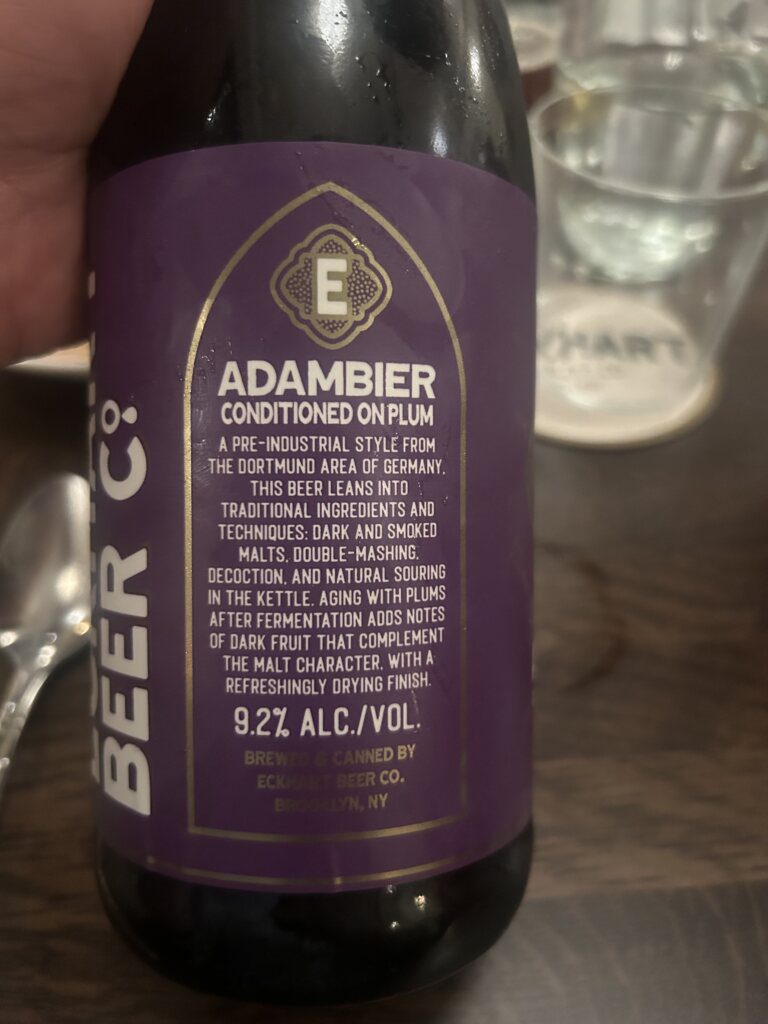
Eckhart, which opened in September, 2025, has a menu, beer list, and drinks menu that feels extremely intentional. Everything on the menu has a reason for being there and everything feels in its place. Bonus points are awarded for having not one, but two French ciders in addition to an impressive wine and non-alcoholic and soft drinks list.
While at Eckhardt, I had the chance to meet legendary podcaster and former restaurant owner, Jimmy Carbone, for a quick bite. I had the cucumber salad with dill and creme fraiche and Carbone enjoyed the beet salad with dried cherries, chili crisp, and lemon tahini. First up was their Helles, a lovely welcome back to Brooklyn, as I hadn’t been in the borough in ages. Carbone had come into NYC and I was lucky enough to find him on the off chance he was back in his old stomping grounds, fresh from Amtrak. Carbone is a self-described “train guy” and more so than that, his podcast is 17 years old; it’s a great resource for anyone looking to do research on what the beer scene was like in NYC in 2009 and today. I often find myself going through old episodes to better provide you, dear reader, with situational awareness of the changes our scene has seen. In two months this episode will be a decade old! Of course the DC Beer scene is not the NYC beer scene despite being only a few hours away, but it feels impossible not to pick up on similarities between the two cities.
Carbone owned Jimmy’s No. 43, which was the first place I ever got to try Uerige Doppelsticke Alt, about 20 years ago, and a beer that still holds high regard in my mind today. While Jimmy’s No. 43, the grand place at 43 7th Avenue is gone, memories of the delicious food and delightful beers I had there live on.
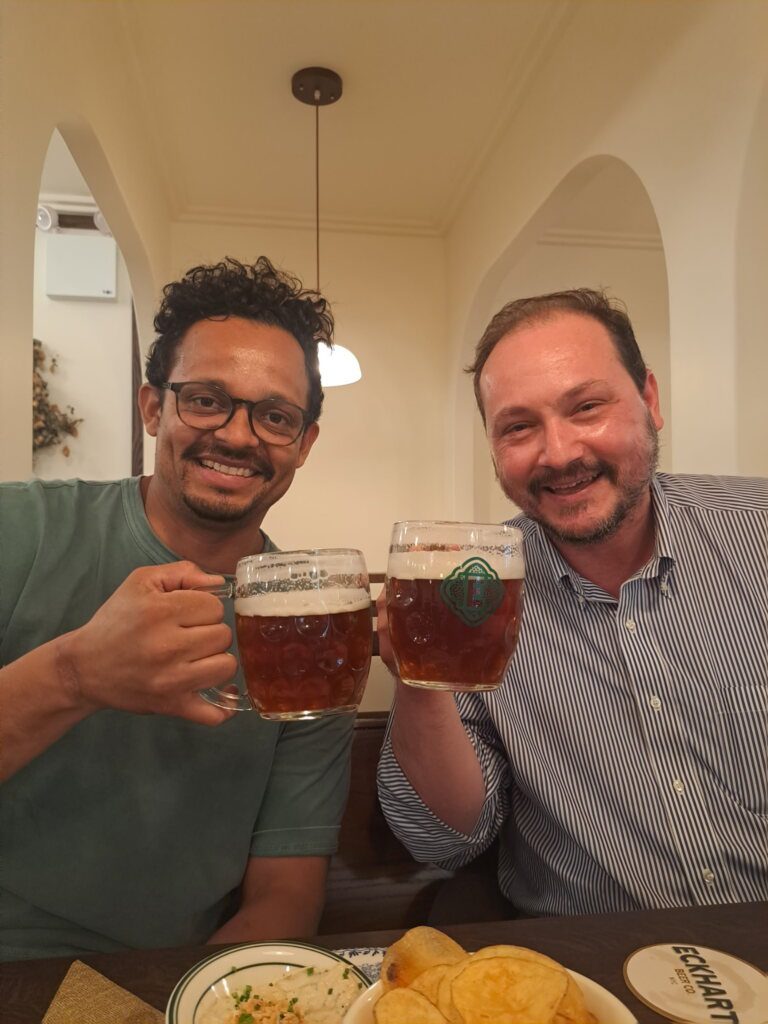
Carbone left and I was joined by Michael Jackson Foundation board member Rafael D’Armas. D’armas has a robust brewing resume, having worked for Kings County Brewers Collective, Montclair Brewery, and now brews at Other Half in Brooklyn. He has a unique perspective on brewing and history, and our conversations were memorable. He is no doubt responsible for many of the hoppy beers you’ve had from Other Half.
Speaking of hoppy beers, some quite strong, I have to say one standout about Manhattan, Brooklyn, and Jersey City, is the culture of selling singles. One can at a time. If we’re talking about an 8-10% alcohol by volume double IPA, it makes sense that these would be sold one can at a time. But it also works for say a Jolly Pumpkin Blanca, which per the brewery is a “Farmhouse Witbier” spending two months in oak foeders packaged in a 12 oz can, at a strength of 4.8% ABV. I was gobsmacked and delighted to find this as a single in Jersey City. Jolly Pumpkin is, regrettably, no longer available in the DMV.
Staying in midtown, I popped into at least a half-dozen bodegas where single cans were plentiful. Tallboy 16 ounce cans, stovepipe 19.2 oz. cans, and some 24 oz. cans as well. Large, national brands like Voodoo Ranger/New Belgium, accompanied by crafty mainstays like Brooklyn Lager, Sierra Nevada Pale Ale, and America’s #1, 2, and 3 beers: Modelo, Michelob, and Bud Light. It was not uncommon to walk into a bodega and see a single 12 oz serving of a Guinness Draught, Extra, or a Sierra Nevada beer missing from its six pack. This would, in my humble opinion, be uncommon in DC, if not outright discouraged. Full four packs and six packs are the rule of the land, though of course you can purchase the errant 16 or 19.2 oz thanks to a DC City Council ruling. Reflecting on her time as owner of the Craft Beer Cellar, Erika Goedrich, who is now managing Brookland’s Right Proper Kitchen, mentioned that she had to get the law changed in order to be able to sell singles and mix-and-match packs. Even then, Goedrich had to go through a year where it had to be at least two singles, even for 750 milliliter bottles, and they abided by the ruling: every beer needs a buddy. She then had to apply for an exception so she could sell a single bottle or can.
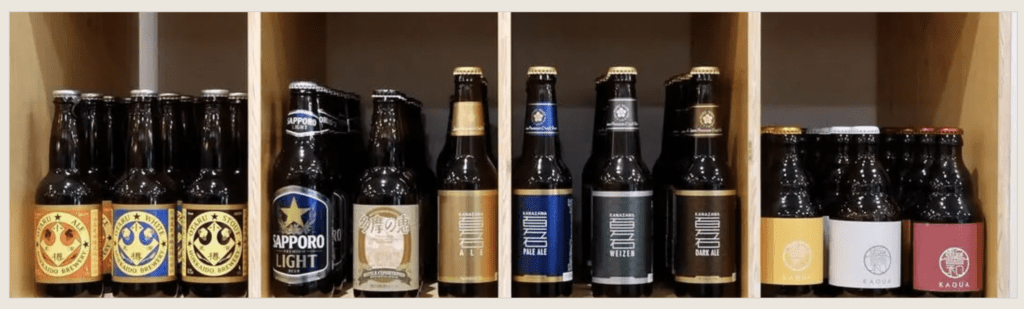
It seems counterintuitive, but perhaps the singles-selling culture is more conducive to what the industry folks call a higher sales velocity. Not every midtown Manhattan bodega-like shop stocked Brooklyn, Sierra Nevada, Voodoo Ranger, Narragansett, PBR, Sapporo, Orion, Kirin, Heineken, Kyoto, Far Yeast, Echigo, Lucky Dog, and Guinness all the time. But between the “Gourmet Deli,” and the next “Gourmet Deli” four blocks and an avenue over, rest assured all of these brands were represented. Over the course of several hours all of these cans, be they 12 ounce, 16 oz, 19.2 oz, or even 24 oz, had a high sales velocity. In DC, Advisory Neighborhood Commissioners, better known as ANCs can make selling singles easier or more difficult. Consider a sign at Logan Circle’s Rice Market, which states you have to buy at least two. No single sales permitted.
Compare this to my experience in Jersey City. A friend wanted a double IPA, something hoppy and bold, one you don’t need more than one of. She ran out to one of her locals and asked if I’d like to join. Would I ever! We popped into Thirsty Quaker, a Jersey City staple, especially for homebrewers and winemakers, as carboys, airlocks, and hydrometers are on full display. Just past the homebrewing/winemaking kit was a cooler full of tons of singles, from Edmund’s Oast and Westbrook of South Carolina as well as the aforementioned Jolly Pumpkin in 12 oz cans. But also represented was a Jersey City staple, the local concern Departed Souls. It got me wondering if this kind of culture could exist in DC? Or perhaps it does exist in Richmond, Virginia, or Baltimore, Maryland, or somewhere not as far flung as NYC?
Of course the singles sales looked very different in Midtown compared to Jersey City. Many people don’t live in midtown, the way Jersey City felt like a real community with a majority of neighbors being on a first name basis with the folks who live next door.
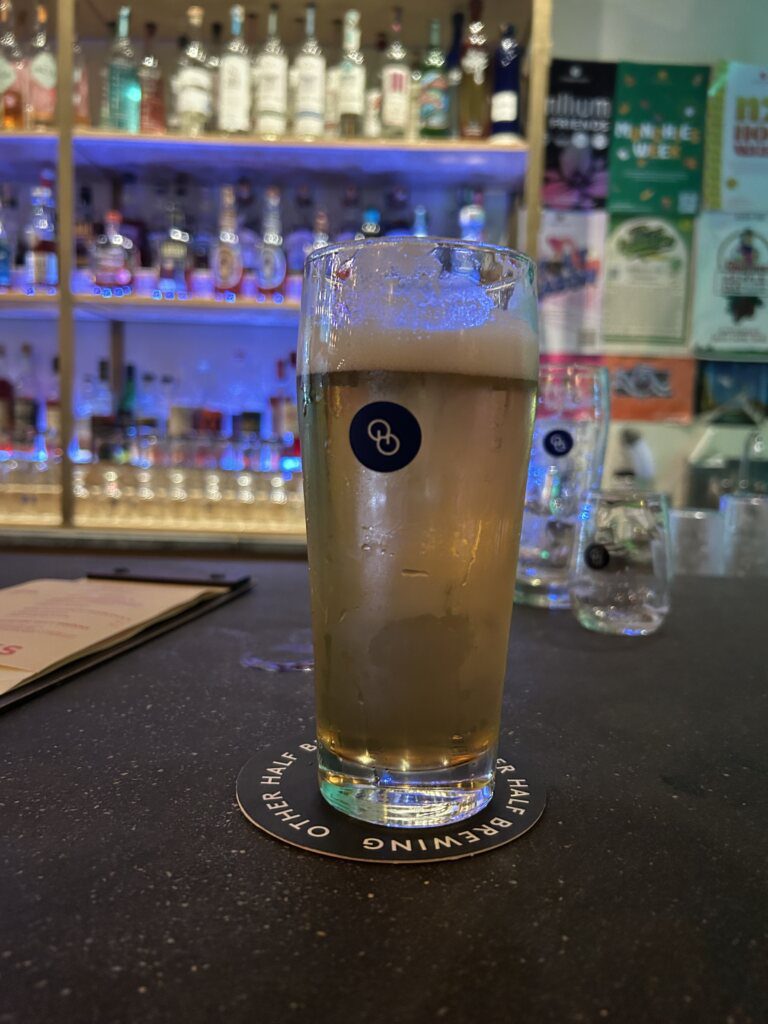
Finally, I closed out with a Crispy Morning at Other Half Rockefeller Center. It’s a beer brewed at Finback Brewery, another uplifting brewer in the NYC scene. Good bitterness, enjoyable aromatics for Pilsner, and it came across as a hop-loaded take on the style if nothing else for the use of the delicious New Zealand hop, Motueka. Years ago in NYC, I recall more bitterness in beer, something that seems to have largely dropped out of craft beer of late. So as new as this beer was, it reminded me of the days of drinking high quality beers when brewers favored IPA to be much more bitter than Pilsner. The irony of this Pilsner is that it seemed more bitter than some of the pale ales and IPAs on offer at 30 Rock. Maybe it’s a gross and unfair generalization that Pilsner is now more bitter than IPA, but writ-large with the proliferation of aromatic IPA, bitterness seems to be on the back burner while West Coast and New Zealand-style Pilsners pack a hot side hop punch. All this to say, if you get a chance, try the Finback Other Half collaboration as I found it quite lovely on Lukr at Rockefeller Center.