


Since colonial times, brewing in the Potomac, Anacostia, and Tidewater regions of DC, Maryland, and Virginia have included adjuncts. Over the centuries, from 1619 to today, ingredients like molasses, persimmon, and wheat bran have been swapped for 21st century ingredients like sugar, oats, and raw and malted wheats.
Saying nothing of Maryland rye, a grain once synonymous with famous rye whiskey made in Maryland, I could discuss the important work of a relatively-new maltster like Bear Branch Malt in Carroll County. Or say how sad we are to know that Murphy & Rude Malting Company out of Albemarle County, Virginia is closing.
For a long time beyond barley, adjuncts like corn and sugar were derided as a less-than-worthy brewing ingredient. In my humble opinion both can be used to positive effect in making world class beer. The same can be said for honey, rice, oats, and similar ingredients that are not malted barley. All of these ingredients have a place in our diverse landscape of beer styles and the several dozen breweries in DC proper and the DMV.
Today we consider corn in two of our oldest breweries: Port City and DC Brau. both turned 15 earlier this year ¡Feliz cumple y feliz quinceañera mi amorcitos!

It’s hard for me to imagine, but Port City’s Chela, their quinceañera beer, a Mexican-style lager, is the first beer they’ve ever brewed with corn. It is indeed mind blowing to me to think of a decade and a half of brewing without corn, though let us not forget the 2011 use of other adjuncts in beers like the 4.9% alcohol by volume Optimal Wit or the 8.5% ABV Tidings. Both feature Virginia wheat, and Optimal utilizes Spanish orange peel, grains of paradise, and coriander. In Tidings, the bigger beer for the colder months, you’re going to experience Virginia wildflower honey, ginger, and cardamom amongst other flavoring adjuncts. Port City has two fruit beers on tap in their tasting room: grapefruit radler and raspberry gose.

Turning from the adjunct of honey to sugar, let us consider DC Brau’s On the Wings of Armageddon. OTWOA to those in the know, debuted in 2012 with a reference in its name to Hopi and Mayan calendars. It has historically used sugar to balance the body of a beer that is over 9% ABV. To my palate, a beer over 9% that is an all-malt product can sometimes taste too beefy if brewed solely with barleys or wheats.
OTWOA is one of the smallest batches of beer that comes out of the NE production brewery. When it was born, it was described thusly:
OTWOA is a single hop beer utilizing Falconers Flight. Brewed with just enough Pale malt, Cara-60, CaraPils and Malted wheat to carry the intense hop character onto the palate.

July marks OTWOA’s 14th “canniversary” and it’s important to remember that the first time the beer was canned was also the first time it was packaged outside of 22 ounce glass bottles. Remember those? No? Go ask your unc or auntie.
We gave OTWOA a wee bit of coverage in 2012.
Putting the strong, hoppy ale into context, you couldn’t yet buy a pint of beer over the bar at a brewery in 2012. This rule, being unable to sell a glass of beer over the bar at a brewery, had to be amended by the DC City Council. That happened later, with the Manufacturer Tasting Permit Emergency Amendment Act of 2014.
Speaking to a former key member of the DC Brau production team about this time period, the demand for the beer was so high, they told me, that one person would be bottling and capping OTWOA, in order to hand the bottle to someone for point of sale and people would literally be buying seconds-old imperial IPA due to the high demand and the attempts to meet DC’s market need. I have yet to meet someone who prefers a 22 ounce bottle of OTWOA to a 12 oz can.

Considering a much smaller (in strength, though not in volume produced) beer, Old Time, we see another adjunct in play, corn.
The brewing of a pale beer to the strength of 4% ABV is a time honored tradition in Washington, DC. It is perhaps a bit bombastic to say that every city, town, and municipality across the country had a pale adjunct lager (typically corn or rice) before prohibition, but it is certainly true that there were thousands of these manufactured throughout our nation’s history, picking up in popularity from the middle of the 19th century up until national prohibition, which came early to Washington DC.

As far as the product differences are concerned, Old Time, conforms more to Optimal Wit, and that they are both under 5% ABV.
My editor is fond of saying that there are two seasons in the DMV: Port City Porter season and Optimal Wit season. Have we weathered the cold snap where dedicated Port City draft lines move from dark to light? You may also see DC Brau’s Old Time with more adjuncts added in the Old Time Cantina variant, sporting not just corn, but also lime and salt.
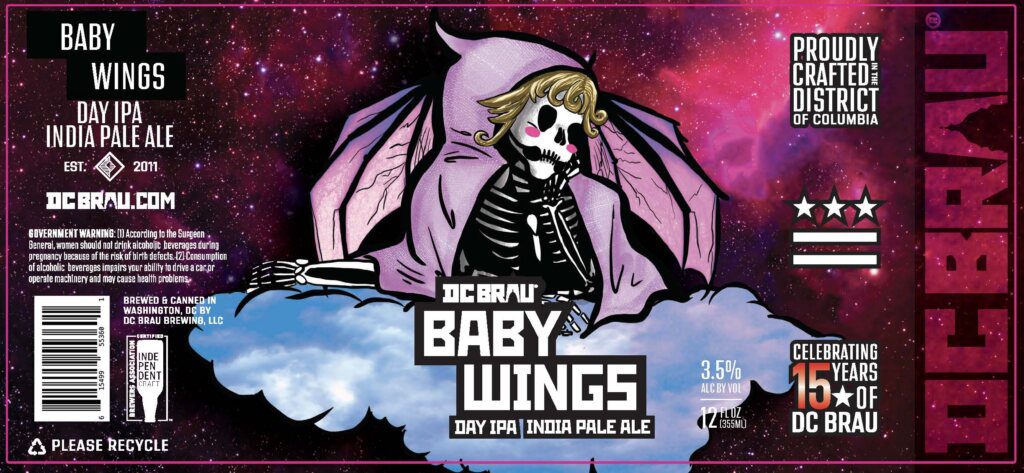
In addition to these tasty adjunct beers it’s worth mentioning that the newly-released DC Brau’s Baby Wings is likely void of the sugar to be found in its big sibling. Similarly all-malt is Helles, Port City’s spring German-style pale lager.
So, go give the decade-and-a-half year old brewers some business. You know we will and hope you’ll do the same.


One response to “How Adjuncts Earned Their Tenure in DC Brewing”
I lived in Arlington at the time and remember being so excited when DC Brau released OTWOA. I was not one of the people who waited at the brewery for a bomber, but I remember being thrilled the first time I found it – I believe it was at Rick’s Wine on Duke St. in Alexandria, but my memory ain’t what it used to be.