


It’s difficult to make heads or tails of what is happening in the DC Beer scene when there is so much beer news out there. Changes are happening all day, everyday. Sometimes there’s so much going on in such a short amount of time that a year can feel like a decade. So I’m asking, and trying to answer, “how’s beer faring? What’s changed and what’s changing?”
It was “kind of a sad trombone year last year” said Kate Bernot, award-winning writer, and director of the North American Guild of Beer Writers last month. Bernot described the news from the Brewers Association (BA), particularly the analysis from Bart Watson, chief economist, that overall craft beer production was down 1%. The BA reported flat growth in 2022, but it was probably more accurately down 0.5 to 1%. Bernot, speaking with podcast host Beth Demmon, noted that these numbers can shift or appear a bit amorphous based on bigger breweries expanding to new markets, or when large multinational conglomerates buy previously independent breweries, among other factors.
Craft beer is not quite 40 years old, and 2022-2023 is the first time we’ve seen two years of negative growth, but production declining isn’t the only historic marker we’re seeing in 2024. There is of course nuance to be carved out of the historic times in which we live. Considering that beer share in general is down, one positive upswing in the beer world is the growth of non-alcoholic (NA) beer.

DC’s biggest brewer and the city’s second biggest brewer both now manufacture NA beer, which is certainly different from everything they’d made prior. DC Brau, DC’s second largest producer, has NA Brau. Other Half DC has All NA Everything. Will we see a third DC brewery release an NA beer? I would venture to say it’s not likely, but being not quite 2.5 decades into the 21st century I have been proven wrong before on what breweries would and wouldn’t do. So DC’s biggest brewery, Other Half, and second largest brewery, DC Brau, are both making nonalcoholic beer. So what? Who cares?
Well, I care. And my hope is that you do too. Over the years I have been pursuing public history, and I like to reflect (more from an everyday person than an academic historian’s perspective) on how more often than not we don’t see ourselves as subjects in history. We often don’t get to take in all of the changes that are going on around us all of the time. I wanted to take some time to reflect on the changes, like the NA beer production that has just come to town in the last two years, but also an even longer time frame to assess the changes we’ve seen. Standing on the precipice of a new chapter in the DC beer world–the NA beer chapter if you will–I wanted to reflect more gradually over the changes we have seen in the DC Beer scene in the last 20 years.
In 2004, I arrived in DC for a Washington semester. What I found was a city with only a few brewpubs and no production brewery. I had beers at Bardo brewpub in Arlington, and at the Capitol City Brewing Company which had two locations, one right next to Union Station and one which still stands today, on 11th and H Streets NW. There were some places to get great beers from far away, places like Pizzeria Paradiso and Brickskeller. The Brickskeller at the time, had amazing beer people who are still working in beer in town today. Hi, Greg! (Engert of Bluejacket and others.) Hi, Rachel! (Murray of Atlas Brew Works.)

As for the brewpubs making beer 20 years ago, Capital City was the oldest of them, having opened in 1992 as the first brewpub since the repeal of Prohibition (with District ChopHouse and Gordon Biersch a few years behind with 1996 and 2001 opening dates respectively). Back then, in 2004, the best selling beer from a DC brewery was likely Kolsch.
I asked several brewers who had brewed at Capital City when the brewery still made beer and most believed Kolsch to be the best seller. One brewer who left in 2004 told me Kolsch was king when he brewed there. Another thought Capital City regularly did over 1,000 barrels a year and a breakthrough year was one where the brewpub hit or got close to 1,500 barrels.
Putting a breakthrough year for Capital City at 1,500 barrels now is a great way to think about beer today: is 15,000 barrels the new 1,500? We may now have two breweries who break that ceiling today, brewing over 15,000 barrels. We know Other Half did >15,000 barrels in DC last year, and DC Brau brewed >15,000 barrels in 2017, 2018, and 2019 (in 2020 every DC brewery lost barrelage due to the pandemic).
Atlas Brew Works now produces Capital City Amber Waves Ale and Capital Kolsch, and brews more of the latter than the former, in keeping with how it was historically. But what’s changed? DC used to be a Kolsch town in terms of the majority of barrels brewed. Today, by the same metric of most-barrels-brewed, DC is an IPA town, as are most places with independent breweries.
The change from a moderately-hopped, easy-drinking pale beer, to a moderately-hopped, somewhat bitter beer that is darker in color than Kolsch is really the story of the rise of craft beer and independent production breweries. I’m thinking of DC Brau’s The Public Pale Ale, which was the first beer out on the market when the brewery opened in 2011. Today, the best seller is Corruption, the brewery’s flagship IPA, which has been reformatted alongside Public, and in my humble opinion, improved, since their inception 13 years ago.

From 2004 to 2014, it’s likely DC’s best selling beer (brewed in the District) went from a lager-adjacent lighter ale, Capital City Kolsch, to a bitter, closer-to-amber colored ale that was more substantive, be it DC Brau’s Public Pale Ale or Corruption IPA. Beer brewed in DC is an important distinction as in the decade from 2004 to 2014, lots of breweries were making more than 1.500 barrels and a lot of those breweries were sending beer into DC. This of course shaped and changed public taste in beer, but it’s a distinction of import as so much more beer remains made outside of DC than within.
DC’s biggest brewer is primarily an IPA brewer. That doesn’t mean they don’t make tasty lagers, stouts, and fruit beers. Or NA beer for that matter. Other Half’s best selling beers are Green City followed by Forever Ever and the DC facility cans and packages these weekly. Forever Ever is described by the brewery as a “Session IPA,” meaning the 4.7% ABV beer is a “low ABV crusher brewed with Mosaic, Azacca and Citra and then double dry-hopped with even more Citra and Mosaic,” so it’s not lost on me that between 2004 and today, 4.7% ABV seems to have gone from a normal-strength beer to a low ABV beer. Considering the Capital City Prohibition Porter is 4.8% ABV, would it too be considered a low ABV crusher? It is of course NOT double dry-hopped and was likely never dry hopped at all.
11 years ago, Kristi Griner was the director of brewing operations at Capital City Brewing Company. When interviewed she said “We have four flagship beers. We have our Capital Kolsch, we have our Pale Rider American pale, our Amber Waves American amber ale… and we also have our Prohibition Porter.” This does not take into account the important, albeit small in footprint, beers that Capital City brewed like Imperial Stout, Gose, Hefeweizen, or a brilliant in clarity, firm in malt, and earthy in nose, ESB. All of these beers, while important, were brewed less often than Kolsch.

Considering the push away from Kolsch and the closure of DC’s biggest Kolsch brewery, things have changed drastically in the past 20 years. We’ve gone from 1,500 being a lot of beer brewed in the city to two breweries who brew or have brewed over 15,000 barrels per year. And you could make the argument that things are radically different from the most popular beers brewed by DC’s biggest brewery, Other Half.
When I looked at all six locations where I could pick up Other Half beers from one of their taprooms (Centre Street, Domino Park, Rockefeller Center, Finger Lakes, Philadelphia, Washington, DC,) all had Forever Ever, Green City, and some had both beers in cans available.
Both Green City and Forever Ever are double dry hopped, meaning they are not only dry hopped, they are dry hopped twice. Considering how new the hops used in these beers are, there is no way these beers could be brewed and dry hopped with the same varietals 20 years ago. This combination of hops was simply not on the market. Azacca (released in 2013), Citra (released 2008), and Mosaic (released 2012): these hops mean this beer could not have existed more than 11 years ago. Or if it did, it would be lacking a hop… literally.
One change that’s charted is the move from the popularity of Kolsch as one of DC’s most brewed beers at Capital City, to the hop-saturated beers, like Green City and Forever Ever, that are so popular at Other Half today. Perhaps a bit reductionist, but whereas Kolsch was clear with minimal hop character, Green City is opaque with a saturated hop character. Sure, they’re both pale, but they are vastly different from a sensory perspective. While you can’t discount the ascendance of highly-hopped, hazy beers, you also can’t rule out the small but mighty Kolsch.
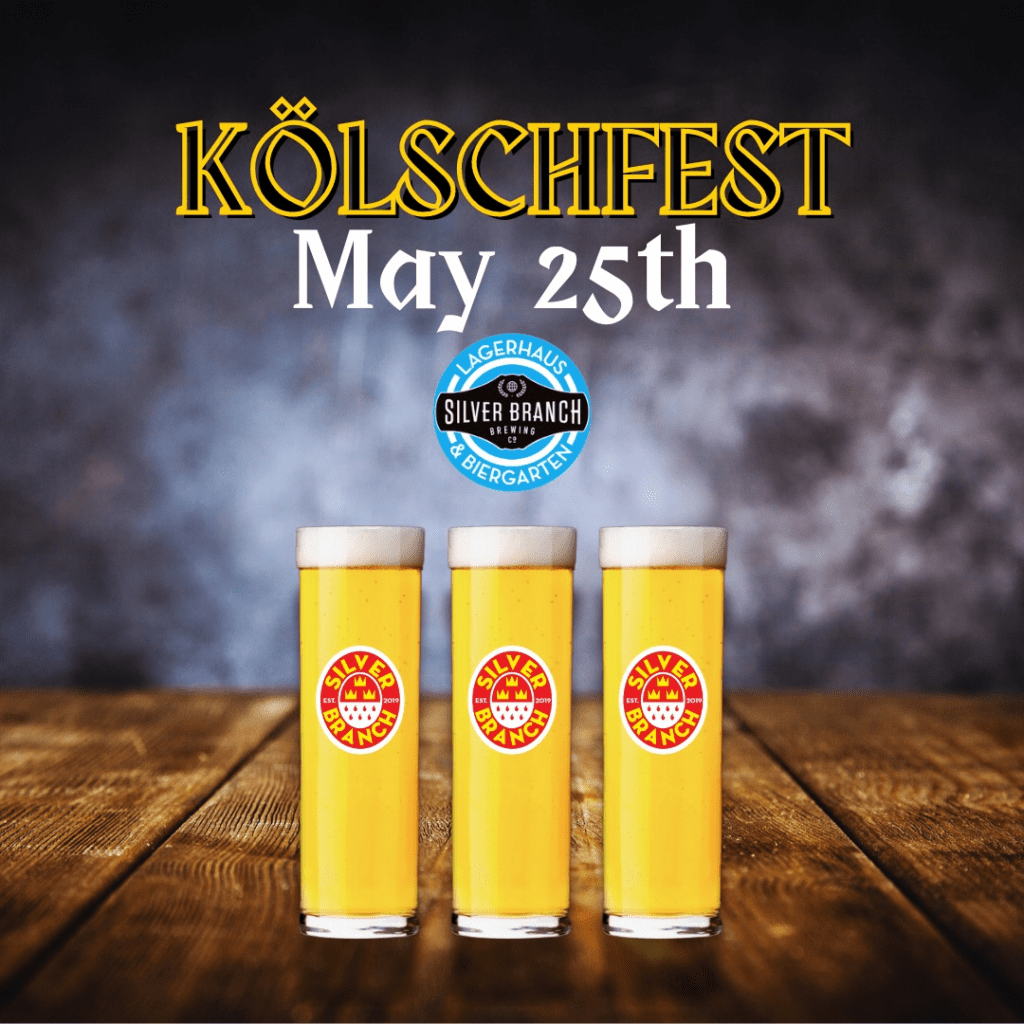 |
Kolsch-style service nights remain popular. When Sebastian Sauer, owner of Freigeist Bierkultur was in town last month, he let me know that not only was Freigeist’s Ottekolong Kolsch style service at the Roost excellent but the sauerbraten was particularly delectable. Consider the Kolsch style service that did so well for Lost Generation that they are doing it again Sunday. Silver Branch is offering Kolsch service as well (see above).
One thing to consider is that while pale ale may rule the roost today, there are still many niche markets to be carved out. There’s NA beer’s positive trajectory while overall craft beer production is down. But then there are also more nuanced examples, unique to our DC metro market.

Consider what DC Brau owner Brandon Skall told us: “Corruption is our top seller overall (combined draft and package sales) but an interesting fact is that Old Time is our leader when considering draft only.” For anyone familiar with Old Time you can certainly see a trace of the easy-drinking Kolsch from the days when 1,500 barrels was a lot of beer for DC’s Capital City to produce.
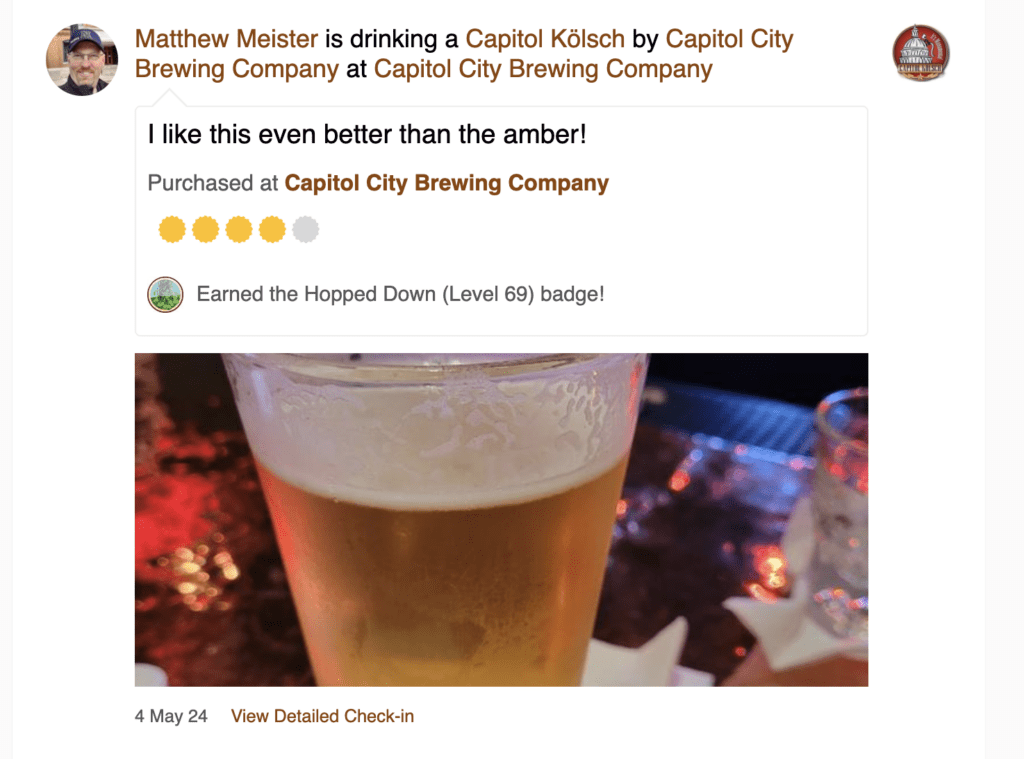 |
I texted a brewer who had left Capital City in 2004 and I asked him what he made of the fact that Capital City had a surprising number of check ins on Untappd for amber and Kolsch. Amber has 9,858 Ratings and Kolsch, 8,357 Ratings. He texted back: “The typical Kolsch drinker is not on Untapped. The person asking ‘what is your lightest beer’ has not heard of Untapped.”


One response to “Ch ch ch ch changes: From Kolsch to IPA (And Back Again)”
Used to frequent the Cap City in Shirlington back when I lived there, 10+ years ago. They always had something in the firkin, and it was always delightful. One of the best beers I ever had was a pumpkin beer from that firkin, and I don’t even like pumpkin beers. They did great work back then – I was quite sad to learn that they’d closed a few years ago.