

Friday I will be at the Smithsonian’s National Museum of American History. The After Hours event is titled Brewing a Revolution and a few tickets are still available.
In preparation for the event, I am reading Michelle Craig McDonald’s book Coffee Nation; it’s really opened my eyes into how much coffee has changed (and in some cases stayed the same!) in the last 250 plus years. I highly recommend this book and if you’re a coffee or history nerd, and even if not, you will absolutely find some things you never knew within its pages.
Inspired by McDonald’s incredibly well researched and footnoted book, I figured I’d dip into the Arlington Public Library’s Charlie Clark Center for Local History. Whilst there I found a thesis published 31 years ago. In 1995, James Cobham Mackay III published a George Mason University thesis titled “The Development of Taverns in Alexandria, Virginia, 1750-1810,” and it’s a great resource because the timeline (while much shorter) overlaps with some of the years covered in Coffee Nation.
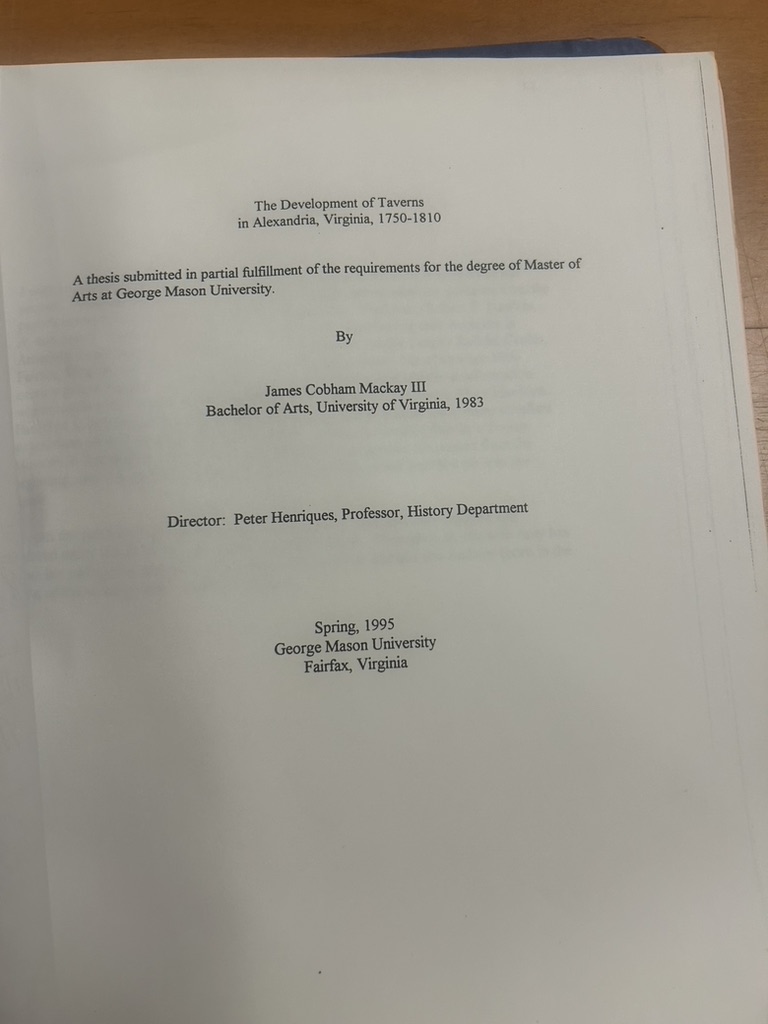
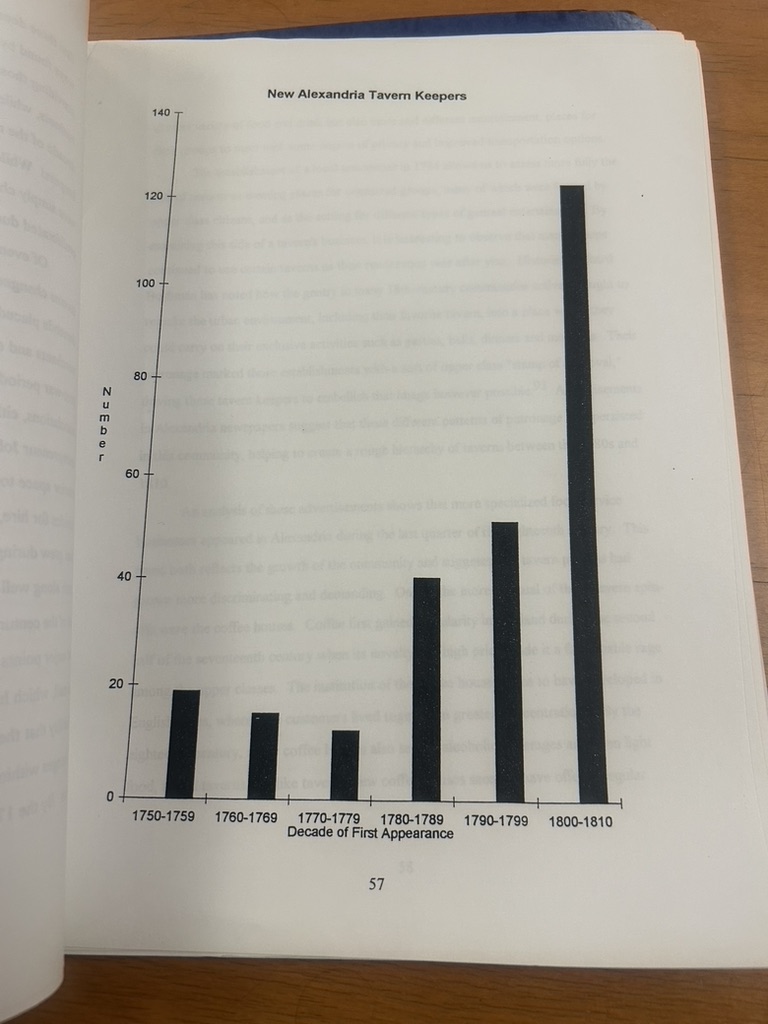
Mackay’s goal was to document a “person’s earliest appearance in the tavern business… earliest documented date at which the person was granted an ordinary license.” A note on an “ordinary,” which in this case is interchangeable with tavern. But just as we might have a “coffeehouse” and a “beer hall” on the same block today, before, during, and after the American revolution establishments began to differentiate themselves by their businesses’ names. Mackay has this graph which shows the incredible rise from 19 tavern owners listed in his “1749-1750s” timeline to the meteoric rise of 122 people listed as owners in the 1800-1810 period.
My editor asked me, ‘why the rise?’ And that is certainly the million dollar question. I don’t have a good answer but it’s a fun fact pattern to trace. Could it be that the Revolution ended? Or that England was engaged in the Napoleonic wars which didn’t end until 1815? Or the growth of neighboring Washington, DC as the young nation’s capital? I don’t know!
Thanks to the thesis we have an enumeration of the ordinary license owners in the 1750s-1810s. As I said, an ordinary is in this case interchangeable with tavern, but not too long after Alexandria’s founding did establishments begin to differentiate themselves. One of the differentiated titles of an establishment was “Coffee House” and The Zebra published a piece about a coffee house in March, owned by Hannah Griffith and according to the Zebra article “was more exclusive than a regular tavern.” The article cites her opening the coffee house in 1794, after the revolution. But women-owned businesses existed in Alexandria well before the 1790s and even the 1770s.
As March was women’s history month, the Office of Historic Alexandria commemorated the women-owned businesses that have been present in Alexandria for at least 269 years. These 269 years are my accounting based on the thesis which lists Ann Mason as holding an ordinary license in 1757. The Office of Historic Alexandria exhibit, Women in Business: We Were Always Here, which opened March 26 at Gadsby’s Tavern Museum, was a highly enjoyable element to my tour of Gadsby’s Tavern Museum which I took in August. I highly recommend paying them a visit and maybe trying a cup of peanut soup. When I visited they had Port City, Old Busthead, Star Hill, Blue Mountain, and Bold Rock on offer under their “brewed locally” menu listing. A few macros, a can of Guinness Draught and a Samuel Smith Oatmeal Stout and Nut Brown Ale rounded out the list.
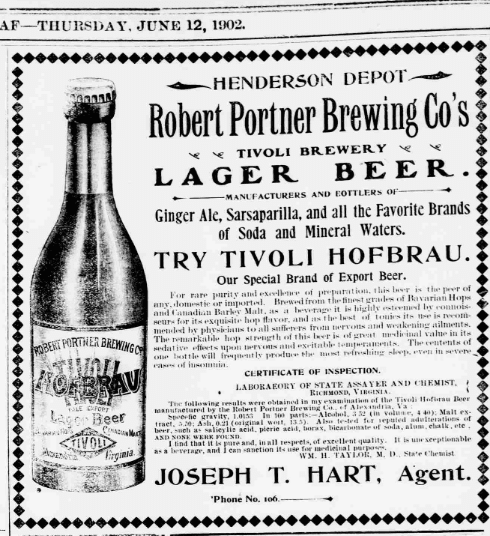
The Zebra article also mentions Griffith’s clientele, stating “[c]offeehouses were typically located in wealthy cities and attracted rich merchant customers. Although most coffeehouse owners were men, some women were in the industry.” Moving from coffee to the ownership outlined in the manuscript “The Development of Taverns in Alexandria, Virginia, 1750-1810” in the Clark Center for Local History, the number of women represented sheds light on the question of ‘who owned taverns and what was their gender?’
The thesis lists 19 owners in the 1750s, 15 in the 1760s, 12 in the 1770s, 40 in the 1780s, 51 in the 1790s, and 122 in the 1800-1810 time period.
| 1749-1750s | 1760s | 1770s | 1780s | 1790s | 1800-1810 | |
| Owners | 19 | 15 | 12 | 40 | 51 | 122 |
| Women | 1 | 1 | 2 | 4 | 2 | 8 |
While my table is not foolproof, you are welcome to look at the thesis yourself as DC is a reciprocal jurisdiction for the APL.
According to the article, “[a]s many as two-thirds of taverns in 17th and 18th century Virginia were run by women.” Based on the article and the thesis, it strikes me that the difference between ownership and who “runs” the tavern is part of the same issue(s) in the restaurant and brewing industry today. The chasm between who runs the tavern and who owns the tavern is vast. Two thirds or as high as 66%, according to the Zebra piece, stands in great contrast to the numbers proposed by the thesis with these percentages ranging from 0.05% to 0.16% at the end of the 18th and leading into the 19th centuries.
Saying nothing of the terrible stain on American history, the brutal dehumanising institution of chattel slavery, ownership has always been tricky. As the article notes, “Griffith may have relied on enslaved labor in the coffeehouse. Records indicate that she enslaved at least one person in her lifetime.”
Similarly to the historic numbers of women who received ordinary licenses, there may be many taverns run by women today, though these highly skilled laborers are not the owners. And of course with small business accounting across the commonwealth of Virginia the numbers of women working and women-owned businesses paints a picture with more parity. According to this 2024 Small Business Administration accounting, “[W]omen made up 47.3 percent of workers and owned 45.0 percent of businesses.”

And while numbers are famously easy to skew, the data sets can leave you with a mixed picture. So here’s one: out of the four places (two breweries, a cidery, and a distillery) which Alexandria Living suggests you visit, two are women-owned. Port City Brewing Co. and Motherwell Distilling are both women-owned. Two out of four is a 50% women-owned ownership rate. But what is the data set? Well, it’s a collection of businesses (really just places listed in an Alexandria Living listicle).
So let’s play with some numbers. If we think of the breweries in Alexandria we see a lower percentage of women-owned businesses. Atlas, Crooked Run, Mieza, and Port City. That would be 25% women-owned.
Out of these four brewing (and blending) companies, only Port City is women-owned. Also out of these, only two have mash tuns and kettles (Atlas and Port City). But from an anecdotal perspective, when I was last at Mieza, I had a wonderful afternoon with Alex Lynch, owner and small brewer of the year. But his mother was labeling bottles, and his father was providing wonderful hospitality to the customers. So while Mieza does not classify as a woman-owned business, you could say that ⅓ (33% of the workforce) were women. In this case the plural seems silly as there were only three people at Mieza working but it displays how easy numbers are to grasp. By my math the historical women-owned taverns look thusly:
1750s = 0.05%
1760s = 0.06%
1770s = 0.16%
1780s = 0.1%
1790s = 0.04%
1800s = 0.06%
So it is in the 1770s that women owned the most taverns by percentages, though only two women owned a tavern. And in the first decade of the 1800s, up to 1810s, the most women, eight, owned taverns. But also in the 1800-1810 time frame, the percentage of women-owned taverns ties the 1760s for the lowest percentage of women owned businesses.
As we public historians love to write: it’s complicated! Hopefully you can appreciate the complexities of history as I work to suss out the tavern trade before, during, and after the revolution.


Leave a Reply